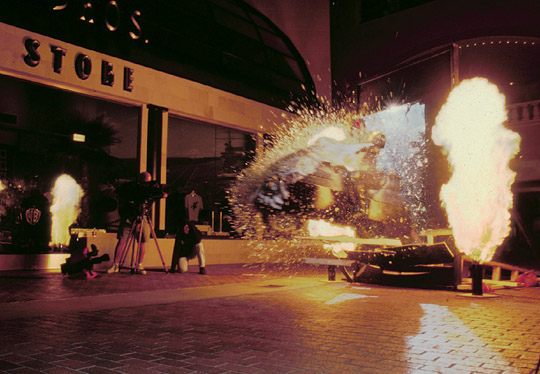
Sometimes we only get one chance at a shot and must predict what will happen and how to shoot it. During filming of a Video News Release for a local shopping mall a motorcyclist rides through a (simulated), plate of glass. Bob is to the left of the scene and has also set up a low angle un-manned camera to double the footage of this one-take shot.
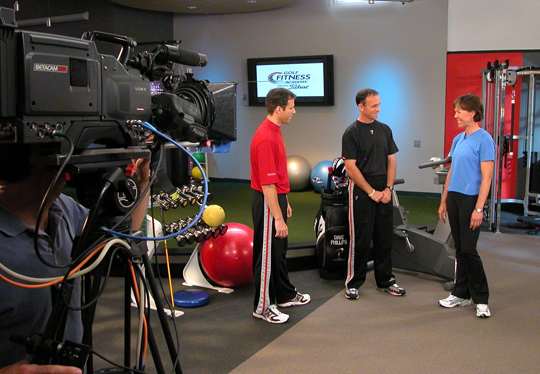
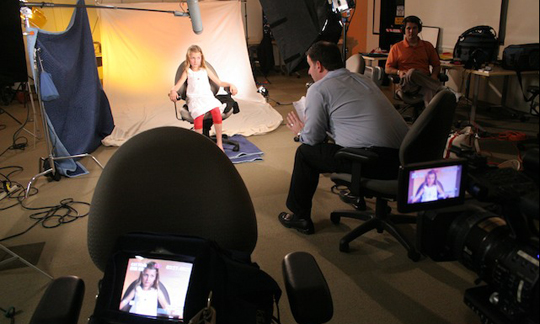
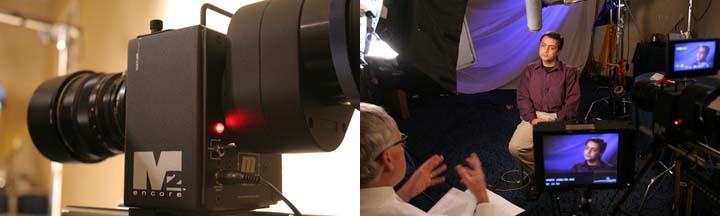

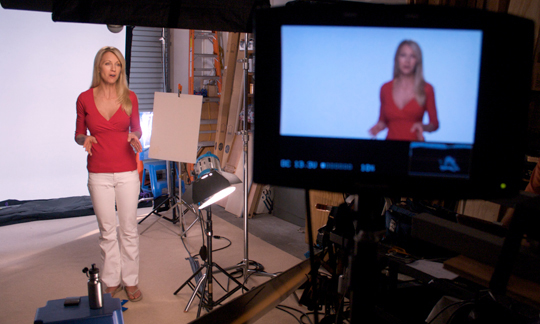
 Kimber is one of my favorite on-camera talent professionals to work with. She is extremely professional, very, very experienced, looks great, and works fast. I highly recommend her to any producer or production company.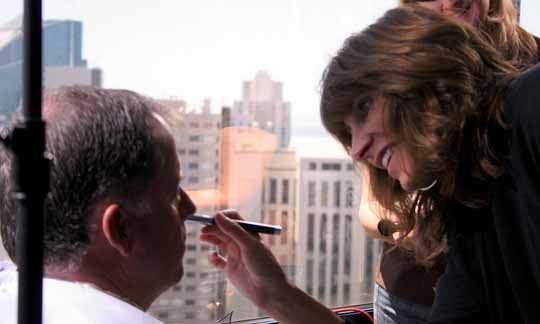
 Every successful production is a result of the execution of each, or a variation thereof, of these elements.
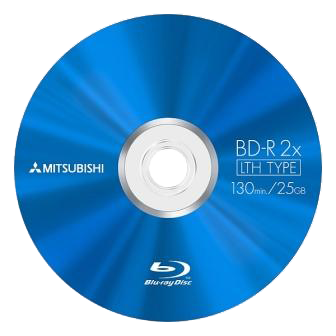 While current optical disc technologies such as DVD, DVD±R, DVD±RW, and DVD-RAM rely on a red laser to read and write data, the new format uses a blue-violet laser instead, hence the name Blu-ray. Despite the different type of lasers used, Blu-ray products can easily be made backwards compatible with CDs and DVDs through the use of a BD/DVD/CD compatible optical pickup unit. The benefit of using a blue-violet laser (405nm) is that it has a shorter wavelength than a red laser (650nm), which makes it possible to focus the laser spot with even greater precision. This allows data to be packed more tightly and stored in less space, so it’s possible to fit more data on the disc even though it’s the same size as a CD/DVD. This together with the change of numerical aperture to 0.85 is what enables Blu-ray Discs to hold 25GB/50GB.